Image of the Day
Apollo 17 at Shorty Crater
P. H. Mikuz and B. Dintinjana (Crni Vrh Obs.,U. Ljubljana)
Comet Hale-Bopp has quite a tail to tell already. This remarkable comet was first discovered in 1995, even before Comet Hyakutake. Since then, this erupting snowball continues to fall into our inner Solar System and is starting to put on quite a show. Comets have been known throughout history to show tails that spread across the sky. In the above picture, the blue stream is the ion tail which consists of ions pushed away from the comet's head by the solar wind. The ion tail always points directly away from the Sun. Comet Hale-Bopp is now visible in the morning sky, moving a few degrees each day. Comet Hale-Bopp is expected to be at its best and brightest in late March and early April.
Other Images
Comet Hale-Bopp Develops a Tail
P. H. Mikuz and B. Dintinjana (Crni Vrh Obs.,U. Ljubljana)
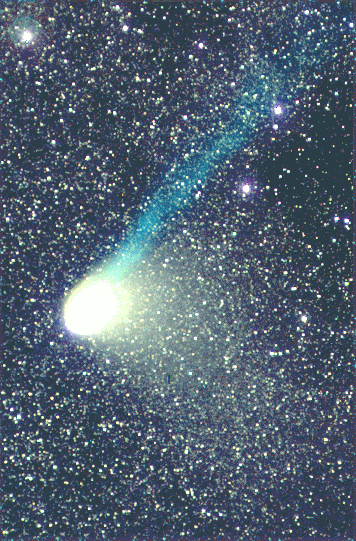
Comet Hale-Bopp has quite a tail to tell already. This remarkable comet was first discovered in 1995, even before Comet Hyakutake. Since then, this erupting snowball continues to fall into our inner Solar System and is starting to put on quite a show. Comets have been known throughout history to show tails that spread across the sky. In the above picture, the blue stream is the ion tail which consists of ions pushed away from the comet's head by the solar wind. The ion tail always points directly away from the Sun. Comet Hale-Bopp is now visible in the morning sky, moving a few degrees each day. Comet Hale-Bopp is expected to be at its best and brightest in late March and early April.
Orbits of Potentially Hazardous Asteroids
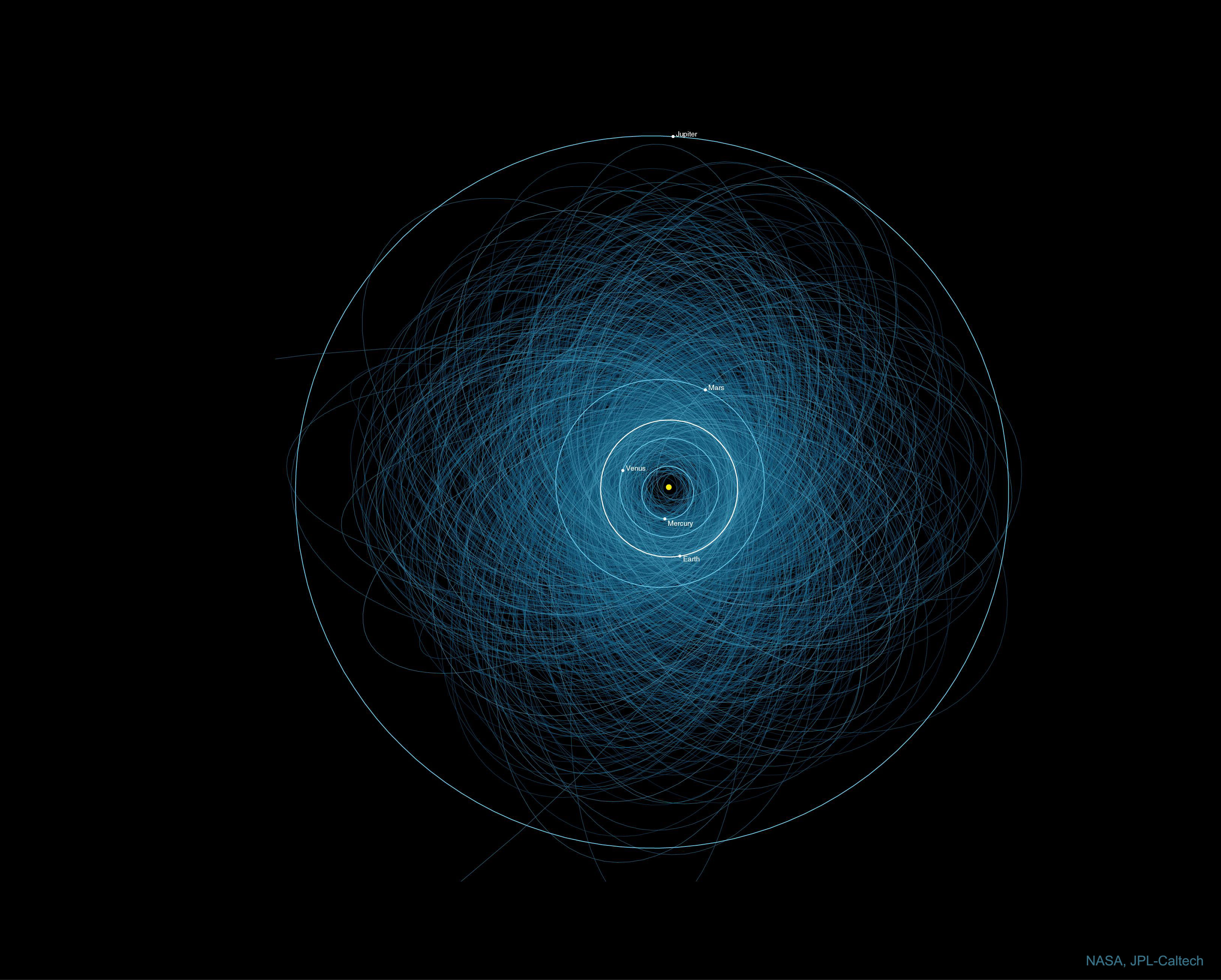
Are asteroids dangerous? Some are, but the likelihood of a dangerous asteroid striking the Earth during any given year is low. Because some past mass extinction events have been linked to asteroid impacts, however, humanity has made it a priority to find and catalog those asteroids that may one day affect life on Earth. Pictured here are the orbits of the over 1,000 known Potentially Hazardous Asteroids (PHAs). These documented tumbling boulders of rock and ice are over 140 meters across and will pass within 7.5 million kilometers of Earth -- about 20 times the distance to the Moon. Although none of them will strike the Earth in the next 100 years -- not all PHAs have been discovered, and past 100 years, many orbits become hard to predict. Were an asteroid of this size to impact the Earth, it could raise dangerous tsunamis, for example. To investigate Earth-saving strategies, NASA's Double Asteroid Redirection Test (DART) is planned for launch later this year. Of course rocks and ice bits of much smaller size strike the Earth every day, usually pose no danger, and sometimes creating memorable fireball and meteor displays.
21st Century M101
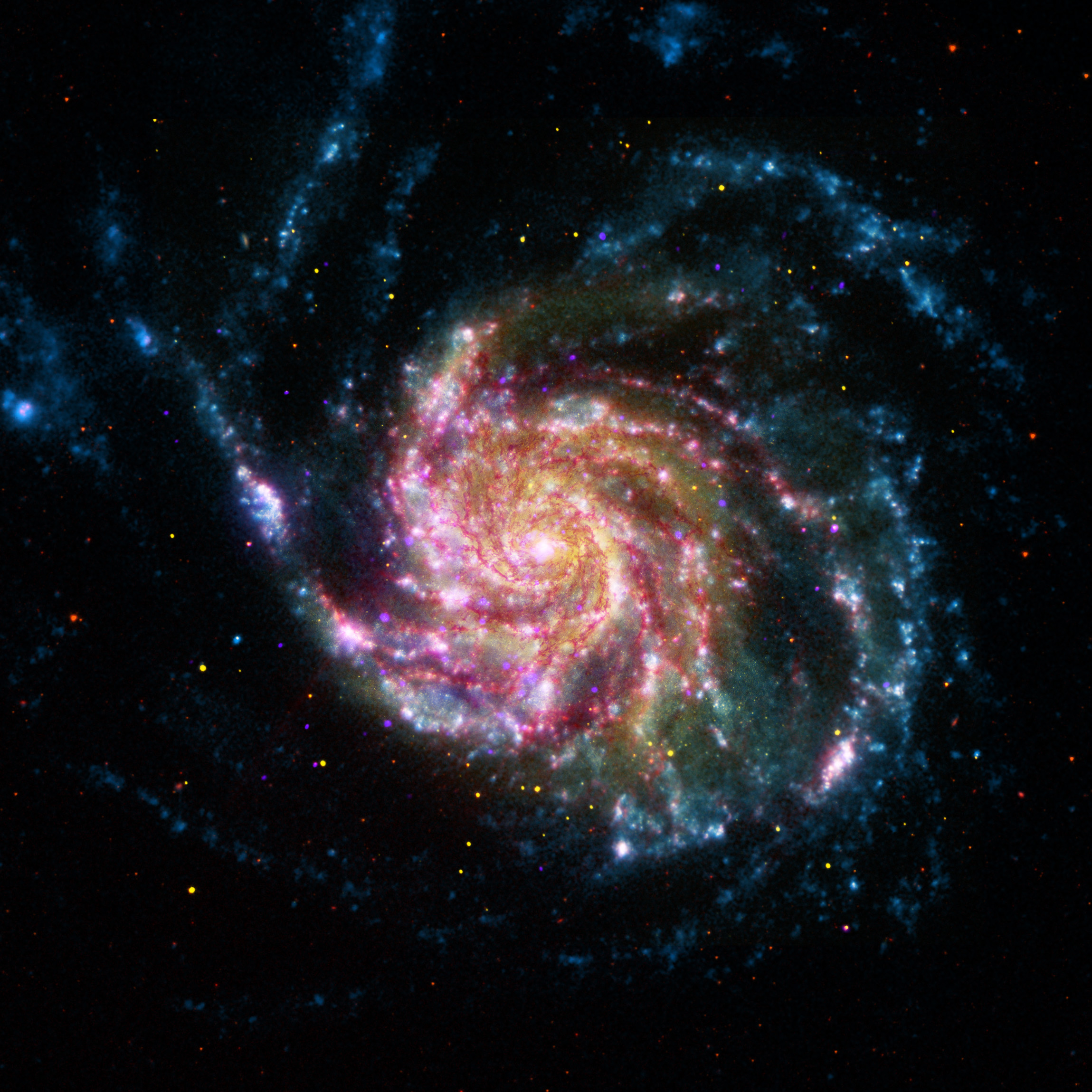
One of the last entries in Charles Messier's famous catalog, big, beautiful spiral galaxy M101 is definitely not one of the least. About 170,000 light-years across, this galaxy is enormous, almost twice the size of our own Milky Way Galaxy. M101 was also one of the original spiral nebulae observed with Lord Rosse's large 19th century telescope, the Leviathan of Parsontown. In contrast, this multiwavelength view of the large island universe is a composite of images recorded by space-based telescopes in the 21st century. Color coded from X-rays to infrared wavelengths (high to low energies), the image data was taken from the Chandra X-ray Observatory (purple), the Galaxy Evolution Explorer ( blue), Hubble Space Telescope(yellow), and the Spitzer Space Telescope(red). While the X-ray data trace the location of multimillion degree gas around M101's exploded stars and neutron star and black hole binary star systems, the lower energy data follow the stars and dust that define M101's grand spiral arms. Also known as the Pinwheel Galaxy, M101 lies within the boundaries of the northern constellation Ursa Major, about 25 million light-years away. (Editor's Note: Original APOD retracted on January 25.)
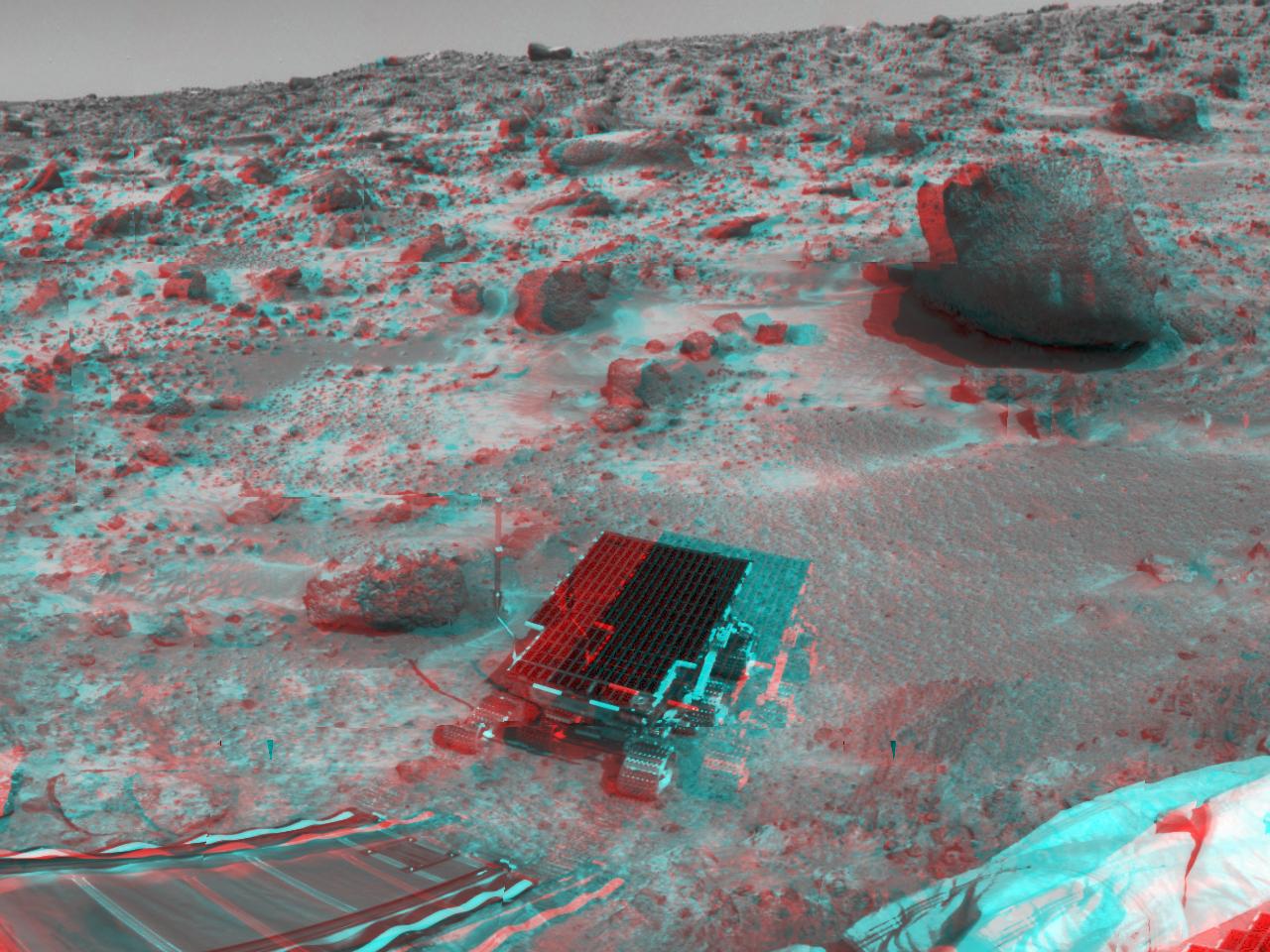
Mars: Yogi And Friends In 3D
A ramp from the Pathfinder lander, the Sojourner robot rover, airbags, a couch, Barnacle Bill, and Yogi Rock appear together in this 3D stereo view of the surface of Mars. Barnacle Bill is the rock just left of the solar-paneled Sojourner and Yogi is the big friendly-looking boulder at the right. The "couch" is the angular rock shape visible on the horizon. Look at the image with red/blue glasses (... or just hold a piece of clear red plastic over your left eye and blue or green over your right) to get the dramatic 3D perspective. The stereo view was recorded by the remarkable Imager for Mars Pathfinder (IMP) camera. The IMP has two optical paths for stereo imaging and ranging and is equipped with an array of color filters for spectral analysis. Operating as the "first astronomical observatory on Mars" the IMP has also recorded images of the Sun and Deimos, the smallest of Mars' two tiny moons. Overcoming communications problems and computer resets the Pathfinder is transmitting new color images which should be available July 18.
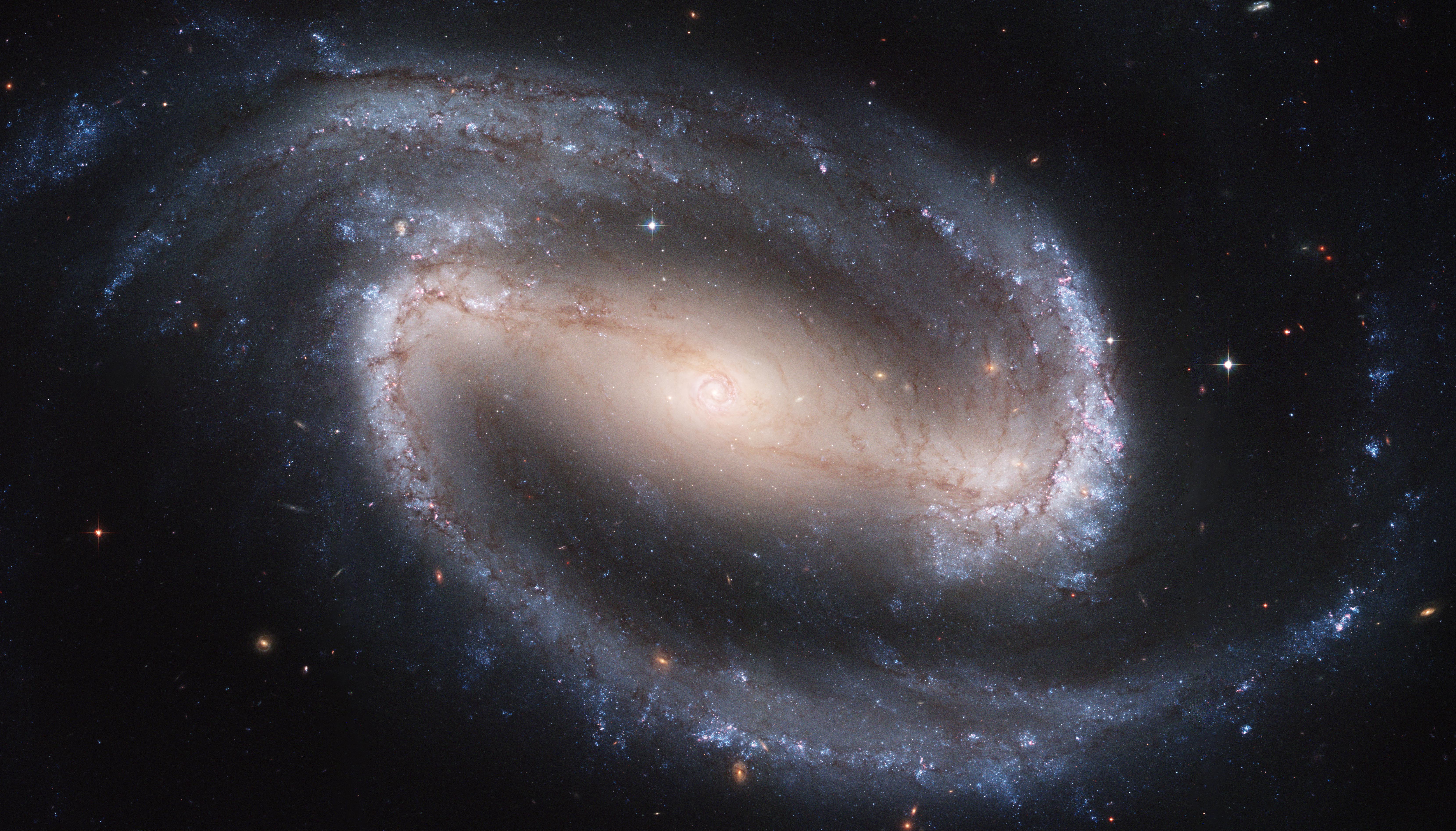
Barred Spiral Galaxy NGC 1300
Big, beautiful, barred spiral galaxy NGC 1300 lies some 70 million light-years away on the banks of the constellation Eridanus. This Hubble Space Telescope composite view of the gorgeous island universe is one of the largest Hubble images ever made of a complete galaxy. NGC 1300 spans over 100,000 light-years and the Hubble image reveals striking details of the galaxy's dominant central bar and majestic spiral arms. In fact, on close inspection the nucleus of this classic barred spiral itself shows a remarkable region of spiral structure about 3,000 light-years across. Like other spiral galaxies, including our own Milky Way, NGC 1300 is thought to have a supermassive central black hole.
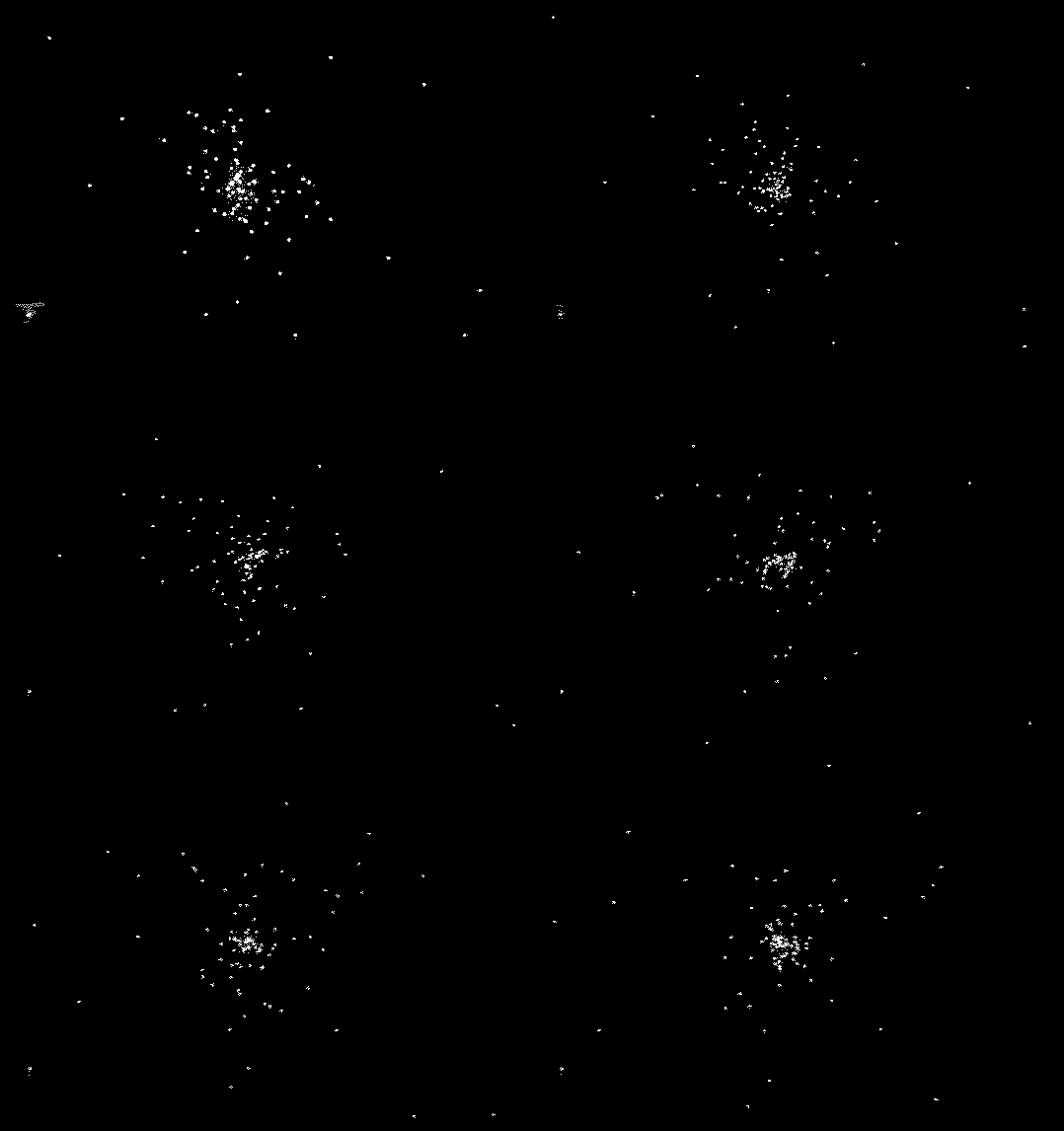
A Star Cluster in Motion
Star clusters are a swarm of complex motions. The stars that compose globular clusters and many open clusters all orbit the cluster center, occasionally interacting, gravitationally, with a close-passing star. The orbits of stars around the cluster are typically not as circular as the orbits of planets in our solar system. Cluster stars frequently fall more directly toward the center and many times trace out unusual and complex loops. The vast space inside a cluster results in stars colliding only rarely. The above computer animation, derived from a type of computer code called an N-body simulation, shows 100 identical stars in a time-lapse movie where hundreds of years pass in one second.

Night on Venus in Infrared from Orbiting Akatsuki
ISAS, JAXA
Why is Venus so different from Earth? To help find out, Japan launched the robotic Akatsuki spacecraft which entered orbit around Venus late last year after an unplanned five-year adventure around the inner Solar System. Even though Akatsuki has passed its original planned lifetime, the spacecraft and its instruments are operating so well that much of its original mission has been reinstated. In the featured image taken by Akatsuki late last month, Venus was captured in infrared light showing a surprising amount of atmospheric structure on its night side. The vertical orange terminator stripe between night and day is so wide because of light is so diffused by Venus' thick atmosphere. Also known as the Venus Climate Orbiter, Akatsuki has cameras and instruments that will investigate unknowns about the planet, including whether volcanoes are still active, whether lightning occurs in the dense atmosphere, and why wind speeds greatly exceed the planet's rotation speed.
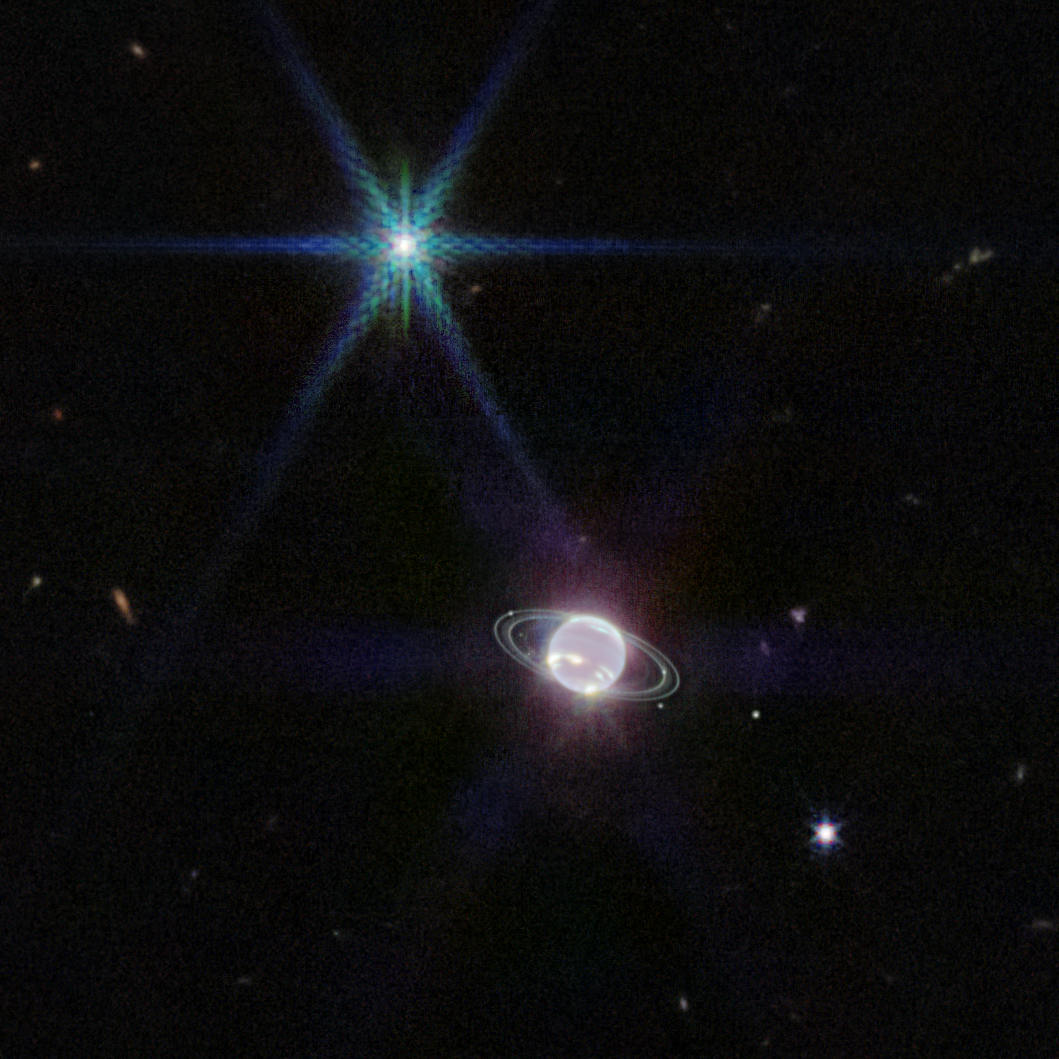
Ringed Ice Giant Neptune
Ringed, ice giant Neptune lies near the center of this sharp near-infrared image from the James Webb Space Telescope. The dim and distant world is the farthest planet from the Sun, about 30 times farther away than planet Earth. But in the stunning Webb view the planet's dark and ghostly appearance is due to atmospheric methane that absorbs infrared light. High altitude clouds that reach above most of Neptune's absorbing methane easily stand out in the image though. Coated with frozen nitrogen, Neptune's largest moon Triton is brighter than Neptune in reflected sunlight and is seen at upper left sporting the Webb's characteristic diffraction spikes. Including Triton, seven of Neptune's 14 known moons can be identified in the field of view. Neptune's faint rings are striking in this new space-based planetary portrait. Details of the complex ring system are seen here for the first time since Neptune was visited by the Voyager 2 spacecraft in August 1989.

Pluto at Night
The night side of Pluto spans this shadowy scene. In the stunning spacebased perspective the Sun is 4.9 billion kilometers (almost 4.5 light-hours) behind the dim and distant world. It was captured by far flung New Horizons in July of 2015 when the spacecraft was at a range of some 21,000 kilometers from Pluto, about 19 minutes after its closest approach. A denizen of the Kuiper Belt in dramatic silhouette, the image also reveals Pluto's tenuous, surprisingly complex layers of hazy atmosphere. Near the top of the frame the crescent twilight landscape includes southern areas of nitrogen ice plains now formally known as Sputnik Planitia and rugged mountains of water-ice in the Norgay Montes.
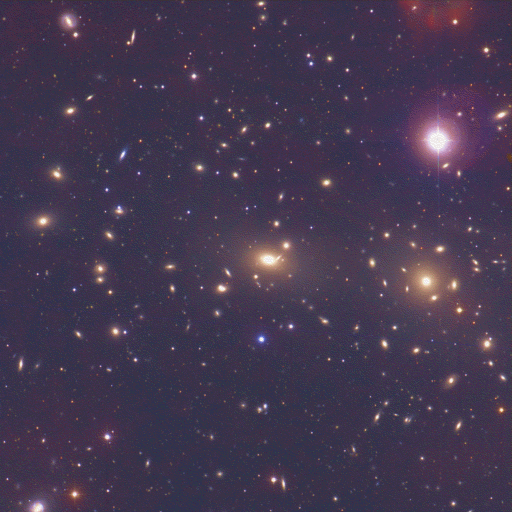
The Coma Cluster of Galaxies Credit:
Almost every object in the above photograph is a galaxy. The Coma Cluster of Galaxies pictured is one of the densest clusters known - it contains thousands of galaxies. Each of these galaxies house billions of stars - just like our own Milky Way Galaxy. Although nearby when compared to most other clusters, light from the Coma Cluster still takes hundreds of millions of years to reach us. In fact, the Coma Cluster is so big it takes light millions of years just to go from one side to the other! Most galaxies in Coma and other clusters are ellipticals, while most galaxies outside of clusters are spirals. The nature of Coma's X-ray emission is still being investigated.